
Insolvency risk analysis in the DACH private market
How can you make a reliable assessment of insolvency risk when only a limited set of financial metrics is available?


Contents
Valuing private companies in Germany, Austria and Switzerland follows its own rules. In the DACH private market, companies are required to file their annual financial statements with the Austrian company register (Firmenbuch) or the commercial register (Handelsregister), often with a delay of up to twelve months after the end of the financial year. On top of that, small GmbHs (private limited companies) only have to publish an abridged balance sheet without a profit and loss account, whereas larger companies must file full annual financial statements. Precisely where risk is hardest to assess, the available data is at its thinnest. While listed groups offer real-time data and analyst consensus to rely on, the Mittelstand – the privately held mid-market – is often shrouded in ‘information fog’.
For investors, it is precisely this information fog that creates an opportunity: if you identify insolvency risks earlier than the market, you gain a structural information advantage. In distressed M&A in particular, a reliable early indicator is crucial. It shows which companies are coming under pressure before this becomes publicly visible – and therefore where entry windows are opening, where you gain leverage in purchase price negotiations, or where restructuring needs can be addressed in good time.
This is exactly where ProxDeal comes in. We asked ourselves: how can you make a genuinely reliable assessment of a company’s financial health from structurally limited data such as company register extracts prepared under the German Commercial Code (HGB) or the Austrian Commercial Code (UGB)?
Hard numbers, not room for interpretation
Our analytical system was developed specifically to deal with the weaknesses of the private market. We know that incomplete multi-year data and missing operating metrics are the norm there.
The core of our technology is a meta-analysis that goes beyond looking at individual values in isolation. Our system aggregates and weights different data points in such a way that structural weaknesses in reporting are compensated for. Rather than relying on vague forecasts, our model uses this multidimensional linkage to create an objective data architecture. The result is a robust analysis that remains precise even when the facts are thin, giving investors exactly the early indicator that the typically opaque private market would otherwise withhold.
The methodological foundation
We draw on the best of empirical research, including the Altman Z'-Score, the Ohlson O-Score and the Zmijewski model. Each of these models looks at default risk (over the next 12–24 months) from a different statistical angle, and it is precisely this methodological complementarity that makes the combination so robust.
The Altman Z'-Score
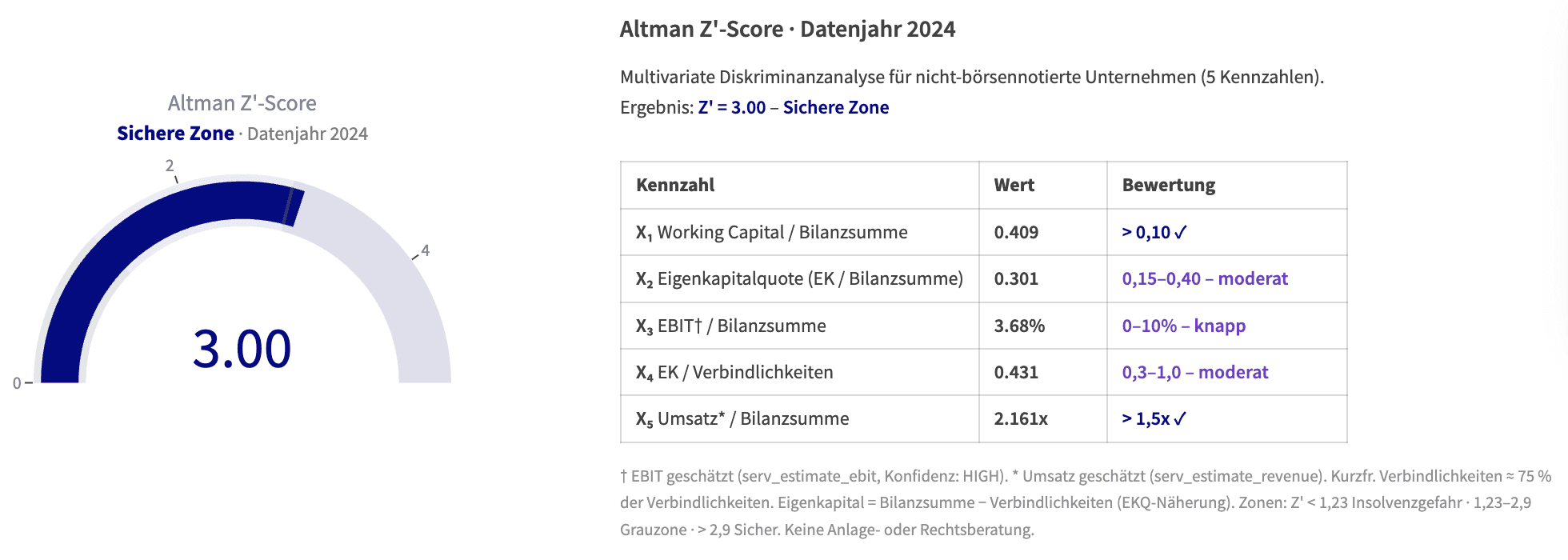
Fig. 1: Altman Z'-Score analysis in ProxDeal – 2024 reporting year. Result: Z' = 3.0 – safe zone.
The Z'-Score is the most practically relevant refinement of Altman’s original 1968 model. Edward Altman developed the method using multiple discriminant analysis (MDA), a statistical technique that separates solvent from insolvent companies by means of a weighted linear combination of balance sheet ratios. Whereas the original version was designed for listed US manufacturing companies, the Z' variant replaces the market value of equity with its book value – which makes the model applicable to unlisted companies.
Specifically, the model uses five ratios: working capital to total assets, retained earnings to total assets, estimated EBIT (statistically modelled using a proprietary machine learning model for DACH financials) to total assets, book value of equity to total liabilities, and revenue to total assets. A Z' value below 1.23 indicates the distress zone, while values above 2.9 are considered sound; the range in between is the ‘grey zone’, in which the model deliberately does not claim to give a clear-cut answer. It is precisely this honest imprecision that is a methodological advantage: the Z'-Score does not overstate the case, but forces the analyst to take a closer look at borderline cases.
The Ohlson O-Score
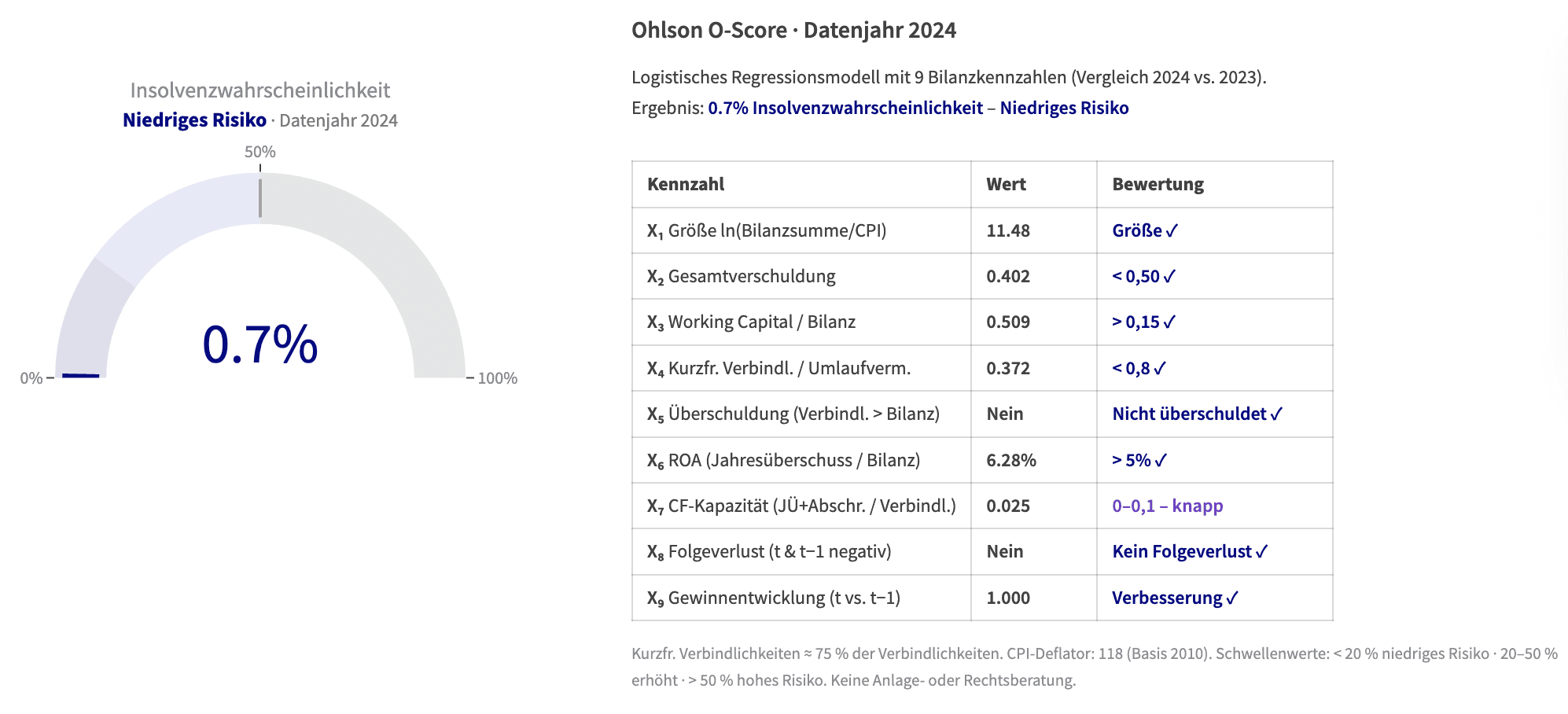
Fig. 2: Ohlson O-Score analysis in ProxDeal – 2024 reporting year. Result: 0.7% – low or no risk.
In 1980, James Ohlson published the O-Score, the first model to express insolvency risk explicitly as a probability. Instead of a discriminant function, Ohlson relies on a logistic regression that combines nine variables: company size, leverage, working capital position, liquidity ratios, net income relative to total assets, cash flow coverage of liabilities, binary indicators for negative equity and for losses in the past two years, and the relative change in net income.
The strength of the O-Score lies in its statistical discipline. Its results can be interpreted directly as a percentage probability of default, which makes it considerably easier to integrate into portfolio reviews and aggregated risk assessments than comparable scoring methods. Particularly relevant to our methodology: by comparing several periods, the O-Score detects warning signs early. Above all, it is the change component (change in net income) and the binary indicators for structural imbalances that capture precisely those patterns that often go unnoticed in a single balance sheet but become clearly recognisable across two or three sets of annual financial statements.
The Zmijewski model
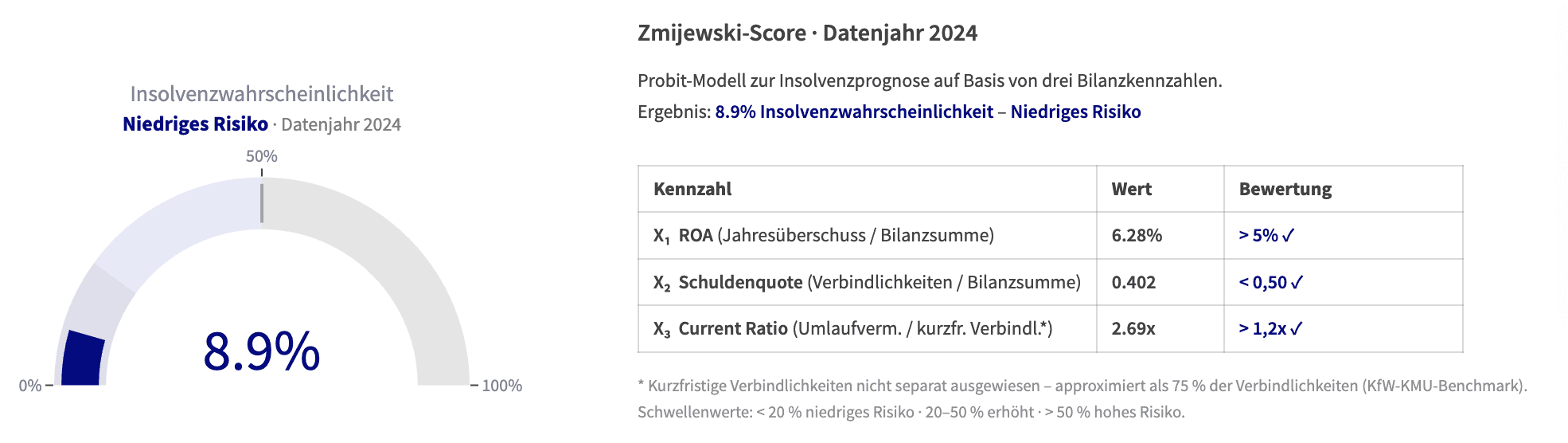
Fig. 3: Zmijewski score analysis in ProxDeal – 2024 reporting year. Result: 8.9% – low or no risk.
In 1984, Mark Zmijewski published a probit-based insolvency model built on a methodologically important critique of Altman and Ohlson: both predecessors had systematically over-represented insolvent companies in their training data, which biases the estimated probabilities of default. Zmijewski corrected this with a ‘choice-based sample’ approach and built his model on a more realistic ratio of solvent to insolvent companies.
The model itself is deliberately lean and uses only three ratios: net income to total assets (profitability), total liabilities to total assets (leverage) and current assets to current liabilities (liquidity). For the private market, this reduction is a decisive practical advantage. While Ohlson often cannot be calculated when data sets are incomplete, Zmijewski remains robust even when individual items in the annual financial statements are not disclosed or are not reported on a comparable basis. In our system, the model therefore serves as a robustness anchor: it delivers a probability of default that can still be calculated when data is thin, and it calibrates the results of the more complex models.
Why combine several scoring models?
These three models form the foundation for the programmatic calculation of the insolvency risk score available in ProxDeal’s filter menu. Internally, we have weighted them to reflect the specific nature of data in the DACH market and extended them into a comprehensive financial health model. The three scores are based on different statistical methods (discriminant analysis, logit, probit), use partly overlapping and partly complementary ratios, and are calibrated to different types of companies and samples. Taken individually, each model has known weaknesses: the Z'-Score is sensitive to balance sheet structure, the O-Score to data completeness, and Zmijewski to the limited explanatory power of just a few ratios. In combination, they offset these weaknesses and deliver a much more stable picture than any single measurement.
From ‘healthy’ to ‘critical’: the four zones
Our model assigns every company to one of four clearly defined health zones:
Zone | Probability of default | Meaning |
|---|---|---|
Financially healthy | 0–15% | Stable foundation, low risk. |
Minor anomalies | 15–40% | Early warning signs, closer review advisable. |
Significant stress | 40–70% | Structural problems, high risk. |
Critical | 70–100% | Acute risk of insolvency. |
This categorisation is far more than theory. It forms the basis of our upcoming valuation system, because a company with a precarious capital position has to be valued fundamentally differently from a healthy one.
The probability of default that places each company in one of these zones is the result of a weighted interplay between the three models. Depending on the depth of data available, the following applies: Tier 1 (one balance sheet year) uses Zmijewski only; Tier 2 (two or more years) combines Zmijewski × 3/8 and Ohlson × 5/8; Tier 3 (two or more years plus EBIT) weights Zmijewski × 3/8, Ohlson × 3/8 and Altman Z' × 1/4. Zmijewski and Ohlson are given equal weight because they complement each other methodologically without duplicating each other: Zmijewski provides a robust baseline signal that remains stable even when data is limited, while Ohlson contributes trajectory signals such as consecutive losses and earnings trends, which a single balance sheet snapshot cannot show. Altman Z' is given the lower weight because its score output is not a native probability and has to be approximated – it serves as a supplementary corrective rather than as an equally ranked main indicator. This keeps the system computable at every level of information and ensures that it consistently delivers a reliable zone classification.
The analytical calculation
Depending on the depth of data available, the probability of default that places each company in one of these zones is derived from one of three formulas:
I₁ (one balance sheet year):
I1 = Pzmij
Required: total assets, liabilities, current assets – all available from a single set of annual financial statements.
I₂ (two or more balance sheet years available):
I2 = 3/8⋅Pzmij + 5/8⋅Pohl
Required: at least two sets of annual financial statements, so that Ohlson’s trajectory signals such as consecutive losses and earnings trends can be calculated.
I₃ (two or more balance sheet years and EBIT available):
I3 = 3/8⋅Pzmij + 3/8⋅Pohl + 2/8⋅Palt
Required: at least two sets of annual financial statements plus EBIT, which for some DACH companies is available directly from the Austrian company register (Firmenbuch) and is estimated otherwise.
In I₃, Zmijewski and Ohlson are given equal weight because they complement each other methodologically without duplicating each other: Zmijewski provides a robust baseline signal that remains stable even when data is limited, while Ohlson contributes trajectory signals that a single balance sheet snapshot cannot show. Altman Z' is given the lower weight because its score output is not a native probability and has to be approximated – it serves as a supplementary corrective rather than as an equally ranked main indicator. This keeps the system computable at every level of information and ensures that it consistently delivers a reliable zone classification.
Practical benefits
The model’s strength becomes clear in practice: hundreds of balance sheets can be screened systematically, without any capacity bottlenecks. Case-by-case estimates give way to a reproducible, data-driven process. In an opaque market, methodological depth is not a luxury but a prerequisite for sound decisions.
Distressed M&A.
A PE fund systematically searching for restructuring candidates can use our model to filter and prioritise thousands of companies by probability of default before a single analyst gets involved. Companies in the ‘Significant stress’ zone that also have a solid asset base are classic distressed targets – targets that, without this early indicator, would remain invisible in the information fog of the private market.
Buy-side M&A.
When assessing an acquisition, the model gives the buyer a structured risk framework even before due diligence begins. A zone classification in the yellow range is not an exclusion criterion, but a clear signal as to which balance sheet items need to be examined in more depth and where purchase price discounts can be justified methodologically.
Lending and insurance.
For lenders and insurers who regularly make decisions on the creditworthiness of mid-market companies, the model replaces time-consuming manual analyses with scalable screening. A company that moves from the ‘Minor anomalies’ zone to ‘Significant stress’ automatically triggers a reassessment of its terms, without an analyst having to step in.
The ProxDeal Insolvency Score provides a single, consistent answer to all of this: a reliable probability of default that works at every level of data and is immediately actionable.
Stay ahead
 Stay ahead
Discover what ProxDeal PRO can do.
ProxDeal is built specifically for the DACH M&A market. Give yourself a decisive competitive edge – starting today.

Related articles

Market Analysis
Revenue and EBIT estimates in the DACH private market
How to correctly interpret ProxDeal’s revenue and EBIT estimates for private DACH companies and use them for M&A and market analysis.
Tutorials
How to find insolvency proceedings in Germany
Research ongoing and concluded insolvency proceedings in Germany using real-time data.

Company Database
What sets ProxDeal apart from traditional databases
AI-powered M&A company search in Germany.